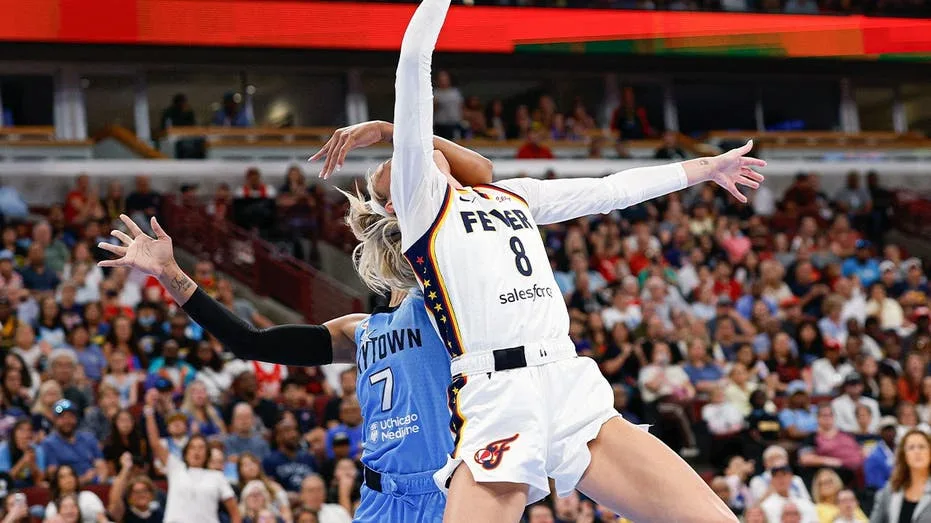
The Women's National Basketball Association has recently drawn public attention, often for contentious issues rather than on-court achievements. A specific incident involving DiJonai Carrington and Indiana Fever guard Sophie Cunningham has particularly captured widespread notice.
The On-Court Incident and Social Media Fallout
The controversy began with an aggressive foul committed by Carrington against Cunningham, which resulted in Cunningham sustaining a bloody mouth. The officiating crew swiftly upgraded the foul to a flagrant 2, leading to Carrington's immediate ejection from the game.
This incident gained further complexity given Cunningham's previous public statements, where she advocated against the inclusion of male athletes in women's sports. However, the situation escalated significantly when Carrington subsequently posted the phrase "White privilege" on social media, tagging the Indiana Fever.
Many observers interpreted Carrington's post as an implication that her ejection and the severity of the foul assessment were influenced by racial factors, specifically that she received a harsher penalty because her opponent, Cunningham, is White.
Despite the immediate public reaction to Carrington's social media statement, the WNBA has largely refrained from commenting on the matter. Carrington herself later addressed the post, offering an explanation that referenced her academic background rather than directly clarifying the initial statement.
"I’ve never once claimed that the assessment of the foul was White privilege (that was your assumption)," Carrington wrote on X in response to analyst Emmanuel Acho. "Try exercising your critical thinking skills, I know you studied psych."
Carrington further elaborated on her expertise:
"Furthermore, I’m the LAST thing from ignorant or asinine when it comes to speaking on 'White privilege,' do ya research on that one. I actually went to school, one of the top universities might I add, to educate myself on this exact subject," she added. "I would never use that term as a rhetorical weapon knowing the historical and social weight it holds without having the proper evidence to substantiate it."
As of late Wednesday evening, the "proper evidence" Carrington mentioned to support her claims had not been publicly provided. It also remained unclear what specific aspect of the incident Carrington was referring to with "White privilege," if not the foul itself or the resulting ejection.
Jemele Hill's Intervention and Partial Clarification
While the broader public remained puzzled, sports analyst Jemele Hill indicated that the meaning was evident to her. On Monday afternoon, Hill posted on X, also in response to Acho's critique of Carrington, stating that it was "pretty clear" to her that Carrington "wasn't talking about the foul."
In the days following Hill's post, numerous individuals, including Acho, questioned her, asking for a clear explanation if the meaning was indeed so apparent. Reporters also sought clarification from Hill directly, requesting that she share her understanding to enlighten the public.
Surprisingly, a comprehensive explanation from Hill was not forthcoming. She did, however, respond to one social media post by reiterating her understanding without fully disclosing what Carrington meant:
"I knew exactly what she meant, especially since Sophie Cunningham wasn’t assessed a technical for her reaction when other players have been," Hill posted.
This partial explanation presents several inconsistencies. Carrington had explicitly stated that her post was not about the foul. Yet, if her concern was Cunningham not receiving a technical foul for her reaction, this issue would still be directly related to the on-court incident. Hill's interpretation, by connecting the situation to Cunningham's reaction, also appears to be linked to the foul in some capacity.
Official Explanations and Statistical Context
Adding to the complexity, officials addressed the question of why Cunningham was not assessed a technical foul immediately after the game. Official Maj Forsberg explained to pool reporters:
"After Cunningham was flagrantly fouled, we deemed her reaction to the severity of the contact to be acceptable."
This explanation suggests that a player's emotional response to a significant physical impact, especially one causing injury, is considered within reasonable bounds. The implication that not receiving a technical in such a situation constitutes "White privilege" seems questionable, particularly since any competitive athlete, regardless of background, would likely react with frustration or anger. It also raises the question of why, if this was the intended meaning, it was not stated more directly, however inaccurate such a claim might be.
A brief review of the WNBA's technical foul statistics further highlights the potential issues with such a claim. Caitlin Clark is currently tied with Angel Reese for the league lead, each having accumulated seven technical fouls. Clark even received an eighth for an accidental bump with an official, though it was later rescinded by the league. In contrast, Cunningham has three technical fouls this season, while Carrington has only one.
The notion that officials refrain from issuing technical fouls to White players on the Indiana Fever is not supported by available data. It does not require an advanced education to verify these readily accessible statistics.
Ultimately, the precise meaning behind Carrington's social media post remains largely a puzzle. It is a mystery that Jemele Hill ostensibly holds the key to, yet for reasons unknown, she has chosen not to fully reveal it to the public.