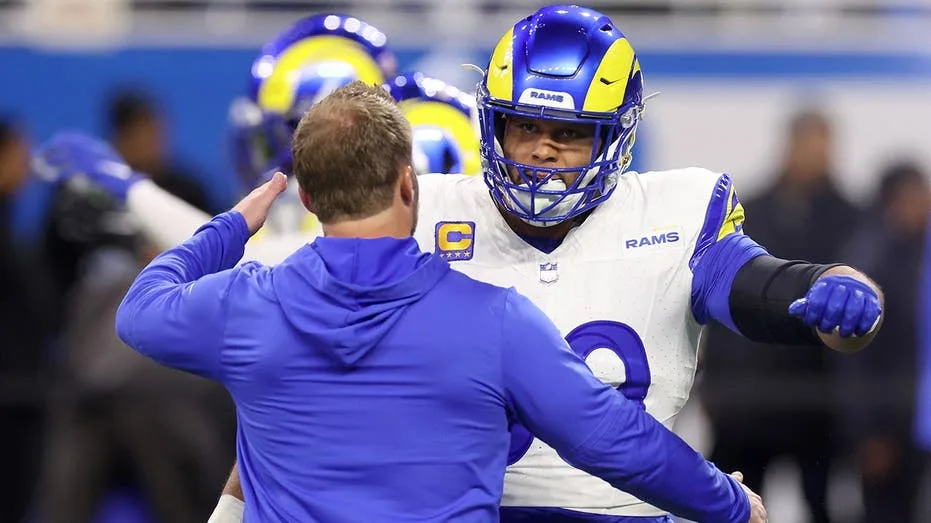
Aaron Donald officially rejoined the Los Angeles Rams earlier this week, sparking questions about how a team with numerous substantial contracts managed to integrate the star defensive tackle under the tight salary cap. According to renowned sports agent Leigh Steinberg, the Rams' adeptness in what he terms "caponomics" made it possible.
Steinberg explained that the Rams achieved this by "creating cap room, redoing someone else's contract so that there's less salary involved and by giving that player a bonus." He added that "If a team is creative, they can move other contracts around and create cap space."
Following their defeat against NFC West rival Seattle Seahawks in last season's NFC Championship Game, the Rams embarked on a significant spending spree during the offseason. They extended MVP-winning quarterback Matthew Stafford with a one-year, $55 million contract, acquired Kansas City Chiefs star cornerback Trent McDuffie via trade and signed him to a four-year, $124 million extension, secured cornerback Jaylen Watson with a three-year, $51 million deal, and brought in Cleveland Browns superstar Myles Garrett, signing him to a five-year, $208 million contract after restructuring his previous deal post-trade.
Despite these substantial financial commitments, the Rams still managed to sign Donald to a one-year, $20 million deal, even while operating close to the salary cap limit. The method, as Steinberg indicated, lies in their inventive approach.
Navigating the Salary Cap: The Caponomics Approach
For Matthew Stafford's contract, the Rams deferred his financial impact into the future by utilizing void years, a mechanism that spreads the cap hit over an extended period. This means Stafford's contract will continue to count against the salary cap through the 2031 season, even if he is no longer with the team.
Trent McDuffie's contract is structured with a backloaded approach. In the current season, McDuffie's cap hit is a manageable $10.8 million, but this figure is set to increase to $30.8 million next season and will remain around that amount for the subsequent three years.
Similarly, Myles Garrett's agreement features a structure akin to both Stafford's and McDuffie's, with a lower initial cap hit and larger figures in later years, also incorporating void years. The reigning Defensive Player of the Year's contract extends through 2030, yet his cap obligations are spread out until 2034. Here are his projected annual cap hits:
- $8.4 million
- $15 million
- $27.57 million
- $39.875 million
- $48.17 million
- $17.523 million
- $11.5 million
- $7.6 million
- $3.3 million (final year, 2034)
To integrate Aaron Donald into their roster of elite players, the Rams have strategically shifted a significant portion of financial commitments into future years, thereby creating the necessary cap space for the present.
A Formidable Defensive Line
Leigh Steinberg believes the acquisitions, particularly bringing Donald back and adding Garrett, will yield substantial dividends. He suggested that combining Myles Garrett, already considered among the best defensive players in football, with "an unbelievably dominant defensive player in Aaron Donald" creates an unparalleled defensive front.
It creates an impregnable line that's impossible to double team. The synergistic effect of this is that an opposing offense can't double team both Aaron Donald and Myles Garrett. So somewhere in there you're going to have this spectacularly dominant player on the loose.
Steinberg also expressed certainty that Donald, who achieved Pro Bowl honors in all 10 of his NFL seasons, would not have ended his retirement unless he was confident in his ability to perform at an elite level. "I am sure that Aaron Donald would not have come back except that he thought he could be dominant once again," Steinberg stated. He acknowledged that "time takes its toll. Being outside of football takes its toll, but it won't take too long for Aaron Donald to be back in form. No other team has two players like this backed up by another three."
Beyond Donald and Garrett, the Rams' defensive line already boasted strength with players like Kobie Turner, Braden Fiske, Byron Young, and Poona Ford. Steinberg posited that the Rams' defensive line could rank among the greatest of all time, drawing parallels to the legendary Baltimore Colts' line from the 1960s.
I think the only thing that would be equivalent was the Fearsome Foursome that had Merlin Olsen and Deacon Jones and Rosie Greer. The Fearsome Foursome is back and as you said, they've got Poona Ford and Kobie Turner and Braden Fiske and Byron Young and they're loaded with gifted players.
He further praised the organization, saying, "The Rams do a better job of scouting players, drafting players, and then finding that one superstar that can be plugged into an already dominating defense or offense." A defensive front comparable to the iconic Fearsome Foursome, which included Olsen, Jones, Greer, and Lamar Lundy, would significantly enhance the Rams' prospects of reaching and winning the Super Bowl.
The Allure of the Game: Why Legends Return
Steinberg, inducted into the California Sports Hall of Fame in 2017, has represented a multitude of high-profile athletes across football and baseball, including Steve Bartkowski, Steve Young, Troy Aikman, Warren Moon, Bruce Smith, Thurman Thomas, Kordell Stewart, Jeff George, Ben Roethlisberger, Myron Rolle, Matt Leinart, Mark Brunell, Ricky Williams, Howie Long, Eric Karros, and Dusty Baker, among others.
Given his extensive experience, Steinberg was not surprised by Donald's decision to return from retirement, noting that many of his former clients harbored similar desires.
I had 64 first-round draft picks, 12 of the players in the Hall of Fame, and when they retired, they did it with class and dignity. But then a couple weeks later, the phone would ring and the player would say, ‘Do you think there's any spot for me? Do you think I can come back?’
The veteran agent explained that these individuals often had peaceful post-career plans and ample financial security, yet they profoundly missed the competitive environment.
They all want to play and when they're away from the game, players miss the structure, the fact that it gives them an itinerary that tells them what they're supposed to be doing every day, what they're supposed to be doing at this time of year. They have structure. They miss the camaraderie in the locker room with the band of brothers that are around them. They miss the electric excitement of performing in front of packed crowds and or many of them from Pop Warner on this is all they've known and so, like the moth to the flame, professional sports is so intoxicating that players never really want to retire.
The Rams are undoubtedly fortunate that Aaron Donald chose to resume his playing career. His return could very well culminate in the team hoisting another Lombardi Trophy.